高等教育におけるニューロダイバーシティの受容と支援 / Neurodiversity Inclusion in Higher Education

*English follows Japanese
高等教育におけるニューロダイバーシティの受容と支援
大石あゆみ(ワシントン大学 人間中心設計工学専攻 修士課程)
日本では2024年4月1日から合理的配慮の提供が義務化されましたが、世界中の様々な高等教育機関でも「単なる合理的配慮」を超えて、ニューロダイバーシティを包摂することの重要性をますます理解しつつあります。神経多様な学生・教員・職員への支援を実践していくにあたり、実際に教育現場ではどのような取り組みが必要とされているのでしょうか。
これらは、2025年10月28日(日本時間10月29日)に開催されたニューロダイバーシティ・ポテンシャル・スタディ・グループ(NeuPoteKen)の第5回ウェビナーで探究した問いです。このウェビナーにはゲストスピーカーとして、ノースイースタン大学におけるニューロダイバーシティ推進プロジェクトのディレクターであるエリック・ブレンナーさんと、千葉工業大学学長としてニューロダイバーシティ・インクルージョンを推進している伊藤穰一(Joi)さんをお招きしました。
1. ニューロダイバーシティをembraceするための文化と環境
人々が神経多様性について語るとき、制度や支援技術の話に注目が集まりがちです。しかし今回のセッションを通じて、最も根底にあるのは神経多様性にまつわる「文化」や「環境」であることがうかがえました。
Joiさんは以前所長を務めていたMIT(マサチューセッツ工科大学)メディアラボでの生徒や大学関係者の特性に関する印象的な表現として次の言葉を紹介しました。(以前のエッセイでも述べたように「特性」は一般的に「個人の特性」や「ユニークな特徴」と訳され、英語の “divergent” のような言葉とは異なり、よりポジティブで強みに焦点を当てたニュアンスを持っています。)
“MITではみんな自分の靴しか見ないけれど、メディアラボの人は相手の靴まで見るよ。”
これはユーモアでありながら、神経特性の違いが前提として受け入れられている文化を示す言葉です。このように神経特性の違いを「矯正する対象」ではなく「存在して当然のもの」として受け入れる文化が存在しますが、ニューロダイバーシティを“embrace(抱きしめる)”という言葉は、この思想をよく表しています。
一方でJoiさんはニューロダイバーシティを“ギフテッド神話”で語ることへの慎重な姿勢を示しながら、個人の能力を環境設計でどう引き出すかといった課題についても触れました。
“ほとんどの天才は自閉症だとしても、ほとんどの自閉症の人は天才ではない。”
映画”A Beautiful Mind”では神経多様な天才主人公の成功ストーリーが描かれていますが、現実世界ではこのような美しい物語ばかりではありません。象徴的な例として語られたのが自閉スペクトラム症の当事者として世界的に知られる動物行動学者テンプル・グランディン(Temple Grandin)の話です。テンプル自身も述べたように、彼女の能力は本人の特性だけでなく、母親の強い支援、教育環境、社会的機会によって開花しました。重要なのは、能力は単純に個人の中に眠っているものではなく「環境との相互作用」で現れる、という視点なのです。
Joiさんはまた、日本で従来取り組まれてきた支援の多くが「本人を社会に適応させる」方向であることを指摘します。アメリカには子どもへの個別支援を学校が法的に提供する義務があり、個人を矯正するのではなく、社会を調整する文化的基盤が見られます。一方、日本やアメリカで多く取り入れられているABAなどの行動療法は一定の効果を持つものの「健常モデル」に近づける方向性が強い側面もあります。このようなギャップを解消するため、ニューロダイバーシティ・スクール・イン 東京(NSIT)では子供の能力を引き出すためのアプローチとして、子供の意志を尊重したフロアタイム、プロジェクト型の学習プログラム、また子ども中心の教育アプローチを導入しているとお話されました。
2. 環境を変える大学:ノースイースタン大学の実践
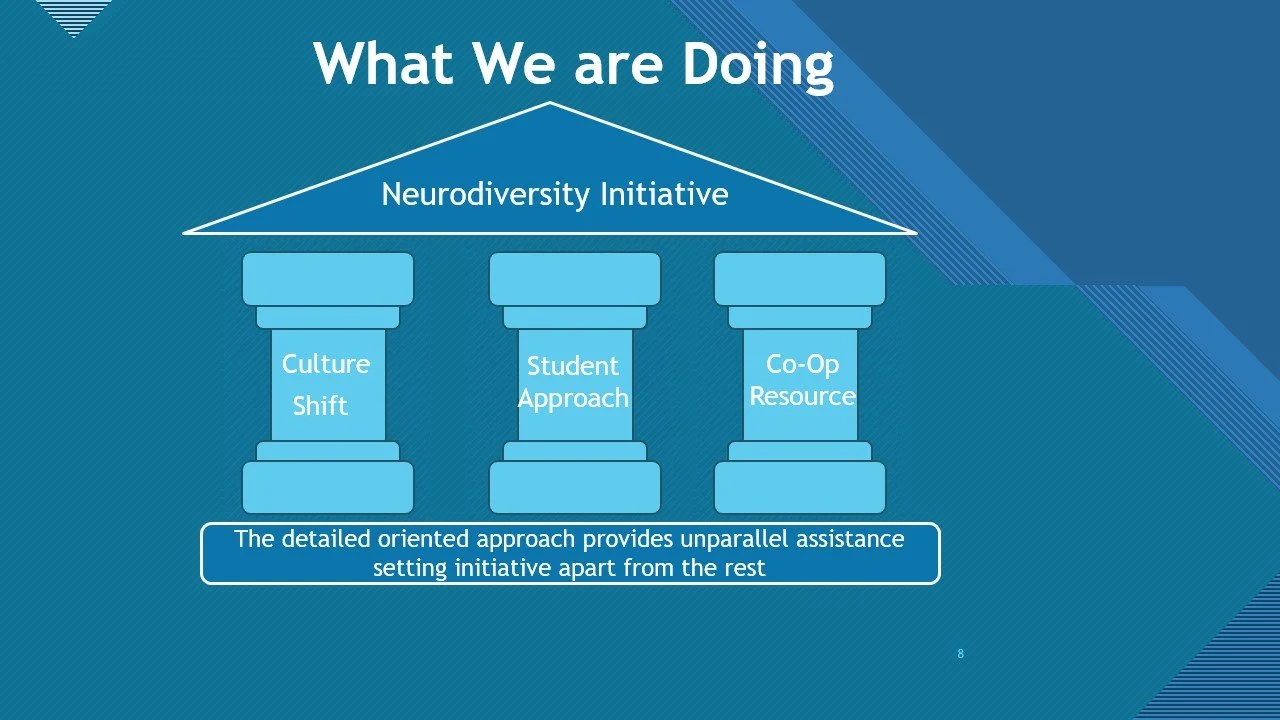
次にエリックさんがノースイースタン大学での示唆的な取り組みを紹介してくれました。ノースイースタン大学ではニューロダイバーシティ推進プロジェクトとして、大きく3つの取り組みを行っています。
まず印象的だったのは、ニューロダイバーシティの定義です。
“ニューロダイバーシティは診断名ではありません。用語です。”
ニューロダイバーシティは診断名ではなく、包括概念であるという立場です。
a. 文化の転換
エリックさんは、取り組みの中心に「強みベースのモデル」を置いていると説明しました。“私たちは個人を変えるのではなく、環境を変えることにより重点を置いています。”
この思想はユニバーサルデザインにも通じます。学生たちの強みを活かせる環境設計として、例えば静かなキャンパス空間、ニューロインクルーシブな教育方法を取り入れたり、そのための教員・スタッフ研修を行いました。“ニューロダイバーシティのために行うどんな変化も、結果的にすべての人にとって有益になります。”とエリックさんは説明します。
実際にニューロインクルーシブな環境を作り出すことが、ニューロダイバージェント以外の生徒を含めてすべての学生に有益である、というのはとても印象的でした。
b. 学生支援
学生団体やクラブ活動、1対1あるいはグループでのニューロダイバーシティ・コーチングを通して、学生一人ひとりに対して社会的・情緒的な支援を行いました。自己理解とセルフアドボカシー(自分のニーズや権利を自分で伝えること)を支援することが、長期的なキャリア形成に寄与するとエリックさんは主張します。ここではニューロダイバーシティ・コーチが学生の実行機能や自己理解の支援を行います。
また、支援をよりアクセスしやすくするためにも取り組みました。例えば、適切なサポートを受ける妨げとなってしまうことから、学生に対して診断書の提出を一律に不要としたのです。
c. 就労支援
Co-opモデルとして、実際に企業での職業体験を6ヶ月実務×複数回で提供します。多くの企業が高い問題解決能力やイノベーションの力を持つニューロダイバージェントなエンジニア学生を求めていることも事実ですが、企業側も変化が求められます。エリックさんは、Dell社がどのように採用や面接プロセスに取り組んでいるかなどの事例も紹介くれました。
”(面接での)プロジェクトや質問は、その学生が実際に仕事で行う内容に直接関係するものであり、行動特性を問う質問ではありません。” 社会的適応やコミュニケーションスタイルを評価する質問(Behavioral questions)ではなくスキルベース・プロジェクトベースの面接採用に重きを置くことで、社会適合性よりも本人の実務能力を評価することが可能となるのです。
3. 組織能力が鍵となるニューロインクルーシブ教育
ニューロダイバーシティ支援というと、多くの場合、学生個人に対する支援制度やサポートプログラムが想起されます。しかし今回のウェビナーを通じて強く印象に残ったのは、ニューロインクルーシブな教育は学生支援の問題ではなく、大学という組織そのものの教育能力に関わる問題であるという点でした。
エリックさんはノースイースタン大学における取り組みの中核として、教員・スタッフに対するニューロインクルーシブ教育トレーニングを挙げています。そこではニューロダイバーシティを理解する基礎知識だけでなく、授業設計や教育実践の中でどのように学習環境を調整できるかについて、専門的な研修が行われています。実際に初年度に600名以上の教員・スタッフを研修し、さらにニューロダイバージェントな当事者の教員が研修に参加し、生きた経験を教育設計に反映させています。
このアプローチは、従来の「学生が環境に適応する」モデルとは対照的です。Joiさんもまた大学単体での変革の難しさに触れながらも、教育文化や制度設計、さらには就労環境まで含めた社会全体の変化の必要性を示唆していました。“やっぱりカルチャーを変えていかなきゃいけない。” ーつまりニューロダイバーシティの包摂とは、特定の支援部門が担う取り組みではなく、大学全体の教育思想や組織文化に関わる課題なのです。
4. 大学から社会へ
ニューロダイバーシティに関する議論は、大学内部の教育支援にとどまるものではありません。むしろ、大学教育と社会・労働市場との接続の中でその課題はより顕著に現れます。
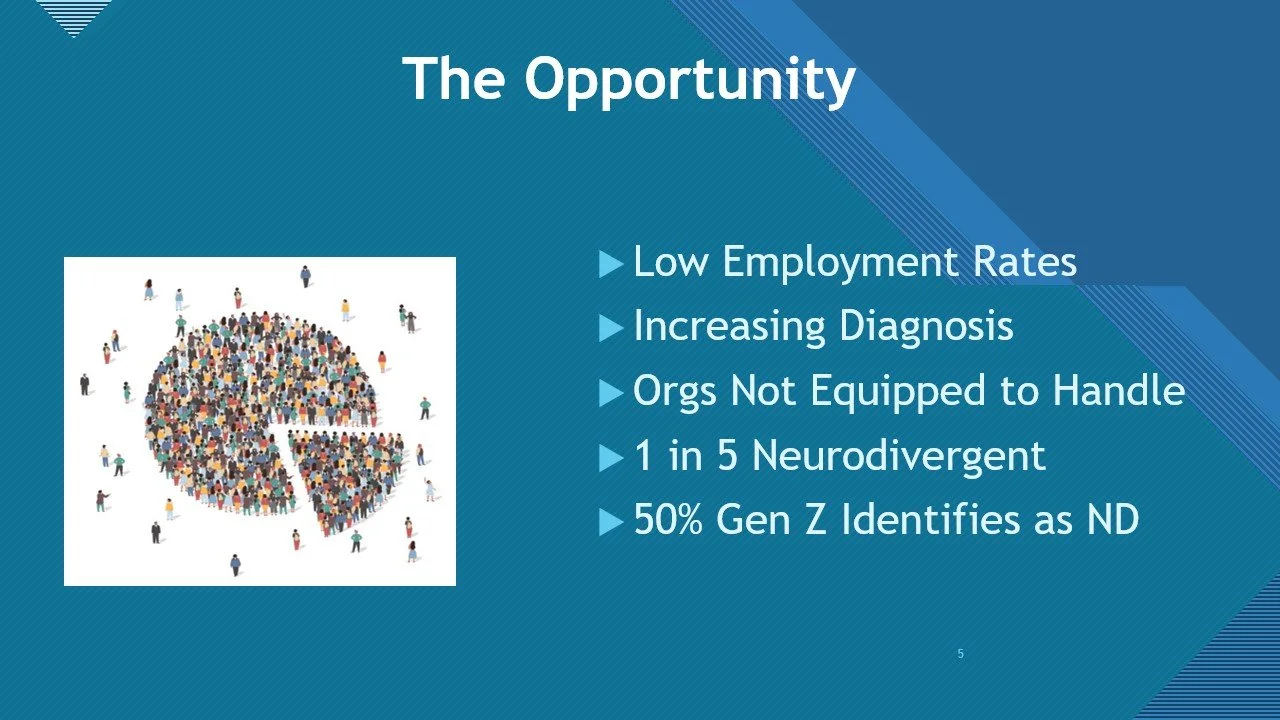
これは個人の能力の問題ではなく、社会側の構造的な障壁によるものであると指摘されています。特に象徴的なのが、就労支援の取り組みでも挙がった採用プロセスの問題です。多くの企業では、実際の業務能力ではなく社会的適応やコミュニケーションスタイルを評価する Behavioral questionsが重視されます。しかしこの評価方法はニューロダイバージェント人材の能力を適切に評価できない場合があり、その代替として、プロジェクトベースやスキルベースの採用手法が有効であることが示されています。
また、職場環境自体も重要な要素です。照明、音環境、コミュニケーションスタイルなどの小さな設計が、能力発揮に大きく影響します。このことは、ニューロダイバーシティの問題が「個人の特性」ではなく「環境設計」の問題であることを改めて示しています。
このように考えると、大学におけるニューロインクルーシブ教育は、単に学生支援を強化する取り組みではなく将来の労働環境を設計し直すための基盤とも言えるでしょう。
5. これからの高等教育ーAI時代とニューロダイバーシティ
AI技術の急速な発展は、教育と労働のあり方を大きく変えつつあります。標準化された情報処理や反復作業は、すでにAIや自動化技術によって代替され始めています。この状況において、人間に求められる価値は標準化された能力ではなく、多様な認知特性や非線形思考、創造性へと移行していく可能性があります。
“ロボットがいろんなタスクをこなせるので、むしろ人間っていうのは、そのロボットができないところに集中した方がいいよね。”とJoiさんは示唆します。
産業革命以降の社会は、標準化された人材を大量に生産することで発展してきました。しかしAI時代においては、むしろ「他者と異なる思考」を持つこと自体が価値になります。ニューロダイバーシティは支援対象ではなく、知識創造やイノベーションの源泉として再評価される可能性を持っています。
この議論は、日本の教育文化を描いたドキュメンタリー Instruments of a Beating Heart にも重なるとJoiさんは指摘します。“日本って、ちょっとハマってない人たちを切り捨ててきた文化が小学校からある。”
この作品では、日本の小学校における集団行動、役割分担、規律、そして共同体への適応が、美しさと同時に描かれています。そこでは協調性や責任感、共同体意識といった価値が丁寧に育まれていく様子が示されています。しかし同時に、このような高度に標準化された教育システムは「平均」に適応しにくい人々にとっては負荷になり得る側面も持っています。均質性の中で成立する美しさは、裏を返せば、異なるリズムや認知特性を持つ人々が参加しにくい構造を生み出す可能性があります。もし社会が「平均」に最適化され続けるのであれば、多様な認知特性を持つ人々の価値は見えにくくなります。“イノベーションが生まれるのは、エッジにいる学生たちからです。” エリックさんもまた、クラスカリキュラムの中で標準化された80%ではなく、エッジとなる20%の学生が実際にはイノベーションを起こし得ると述べました。
“人間はみんなと違うことをすることに価値がある。” Joiさんが述べたように、AI時代においてはこの問いはさらに重要になります。そういったことを可能にする環境は、 教育・企業・社会 すべてが連動して初めて成立します。この観点から見ると、ニューロダイバーシティは教育や福祉の枠組みを超え、これからの知識社会における人間の価値そのものを再定義する概念として捉えることができるのではないでしょうか。
ニューロダイバーシティ・ポテンシャル・スタディ・グループ(NeuPoteKen)は、ニューロダイバーシティやコネクテッド・ラーニングに関心をもつ日英両言語圏の研究者・実践者・デザイナー・政策決定者のコミュニティです。本活動は、東京のNPO法人ニューロダイバーシティ、千葉工業大学変革センター、コネクテッド・ラーニング・ラボ、コネクテッド・ラーニング・アライアンス、金子総合研究室、一般社団法人国際STEM学習協会、ファブラボ鎌倉などの連携のもと運営されています。参加希望・お問い合わせは info@neupote.orgまでご連絡ください。
Neurodiversity Inclusion in Higher Education
Ayumi Oishi (MS Student, Human Centered Design & Engineering, University of Washington)
In Japan, the provision of reasonable accommodations became mandatory on April 1, 2024. At the same time, higher education institutions around the world are increasingly recognizing the importance of going beyond “mere reasonable accommodations” to truly include neurodiversity. As we seek to implement support for neurodivergent students, faculty, and staff, what kinds of initiatives are actually required in educational settings?
These were the questions explored at the 5th webinar of the Neurodiversity Potential Study Group (NeuPoteKen), held on October 28, 2025 (October 29 in Japan). The webinar welcomed as guest speakers Erik Brenner, Director of the Neurodiversity Initiative at Northeastern University, and Joi Ito, President of Chiba Institute of Technology and a leader in advancing neurodiversity inclusion.
1. Culture and Environment for Embracing Neurodiversity
When people talk about neurodiversity, attention often centers on institutional systems or assistive technologies. However, this session highlighted that at the foundation lies the “culture” and “environment” surrounding neurodiversity.
Joi shared a memorable expression from his time as Director of the MIT Media Lab to describe the Tokusei of students and university affiliates there (as discussed in a previous essay, Tokusei is commonly translated as “individual characteristics” or “unique traits,” but unlike terms such as “divergent” in English, it carries a positive, strengths-oriented nuance):
“At MIT, everyone looks only at their own shoes, but at the Media Lab, people even look at the other person’s shoes.”
Though humorous, this remark reflects a culture in which differences in neurocognitive traits are assumed and accepted. In such a culture, neurodivergent traits are not seen as something to be corrected but as something natural and expected. The word “embrace” aptly captures this philosophy.
At the same time, Joi cautioned against framing neurodiversity through a “gifted myth,” and touched on the challenge of how environmental design can help draw out individual abilities.
“Even if most geniuses are autistic, most autistic people are not geniuses.”
The film “A Beautiful Mind” portrays the success story of a neurodivergent genius. In reality, however, not all stories unfold so beautifully. A symbolic example discussed was Temple Grandin, the world-renowned animal behavior scientist known for being on the autism spectrum. As Temple herself has noted, her abilities flourished not only because of her traits, but also due to her mother’s strong support, her educational environment, and the social opportunities available to her. What matters is the perspective that ability does not simply reside within an individual; it emerges through interaction with the environment.
Joi also pointed out that much of the traditional support in Japan has focused on helping individuals “adapt to society.” In the United States, schools are legally obligated to provide individualized support to children, reflecting a cultural foundation that adjusts society rather than correcting the individual. By contrast, behavioral therapies such as ABA, widely adopted in Japan and the US, can be effective but often emphasize aligning individuals with a “normative model.” To address this gap, the Neurodiversity School in Tokyo (NSIT) is implementing approaches that draw out children’s abilities, including child-led Floortime practices, project-based learning programs, and child-centered educational models.
2. Changing the Environment: Northeastern University’s Practice
Erik then introduced impactful initiatives at Northeastern University, where the Neurodiversity Initiative focuses on three main areas.
One striking point was the definition of neurodiversity:
“Neurodiversity is not a diagnosis. It’s a term.”
This position frames neurodiversity not as a clinical label but as an inclusive concept.
a. Culture Shift
Erik explained that their work centers on a strengths-based model.“We focus more on changing the environment as opposed to changing the individual.”
This philosophy resonates with universal design. To create environments where students’ strengths can thrive, they established quiet campus spaces, adopted neuroinclusive teaching practices, and provided training for faculty and staff. “Any change that you do for neurodiversity, it helps everyone,” he explains.
What was particularly striking is that neuroinclusive environments proved beneficial not only for neurodivergent students but for all students.
b. Student Approach
Through student organizations, clubs, and one-on-one or group neurodiversity coaching, the university provides social and emotional support tailored to each student. Supporting self-understanding and self-advocacy, they argue, contributes to long-term career development.
Neurodiversity coaches support students’ executive functioning and self-understanding.
They also worked to make support more accessible. For example, recognizing that diagnostic documentation can be a barrier to accessing support, the university removed the blanket requirement for a diagnosis.
c. Co-Op Resource
Through a co-op model, students participate in multiple six-month professional placements with companies. While many companies seek neurodivergent engineering students for their strong problem-solving and innovative abilities, employers themselves must also adapt. Erik shared examples of how Dell has revised its hiring and interview processes.
“These projects and this question [during the interview] are directly applicable to what the student will be doing when they're doing the job, not behavioral questions.” By prioritizing skills-based and project-based interviews over behavioral questions that assess social conformity or communication style, employers can more accurately evaluate practical competence rather than social fit.
3. Neuroinclusive Education as Organizational Capacity
Neurodiversity support is often imagined as programs directed at individual students. However, a central insight from the webinar was that neuroinclusive education is not merely a student support issue; it concerns the educational capacity of the university as an organization.
At Northeastern, faculty and staff training in neuroinclusive education forms the core of the initiative. This training goes beyond basic knowledge of neurodiversity to include professional development in course design and educational practice. In the first year alone, over 600 faculty and staff members were trained. Neurodivergent faculty members also participated, ensuring that lived experience informs educational design.
This approach contrasts with traditional models in which students adapt to existing environments. Joi also acknowledged the difficulty of transforming a single university in isolation, suggesting the need for broader societal shifts in educational culture, institutional design, and employment systems.“Ultimately, we have to change the culture.” In other words, embracing neurodiversity is not the responsibility of a specific support office; it is a challenge tied to the educational philosophy and organizational culture of the entire university.
4. From University to Society
Discussions of neurodiversity extend beyond campus. The challenges become more visible at the intersection of higher education and the labor market.
This reflects not a lack of ability, but structural barriers within society. A key issue lies in hiring processes that prioritize behavioral interviews assessing social adaptation and communication style over actual job-related skills. Project-based and skills-based hiring methods offer more equitable alternatives.
Workplace environments also matter. Lighting, sound conditions, and communication norms can significantly affect one’s ability to perform. This underscores that neurodiversity is not about individual deficits, but about environmental design.
In this sense, neuroinclusive education in universities is not merely about strengthening student support; it lays the groundwork for redesigning future work environments.
5. Higher Education in the AI Era and Neurodiversity
The rapid development of AI is transforming education and labor. Standardized information processing and repetitive tasks are increasingly automated. In this context, the value humans offer may shift from standardized abilities toward diverse cognitive styles, nonlinear thinking, and creativity.
“Since robots can handle those tasks, humans should instead focus on what robots cannot do,” Joi suggested.
Since the Industrial Revolution, society has advanced by producing standardized human resources. In the AI era, however, thinking differently from others may itself become valuable. Neurodiversity can be reinterpreted not as something requiring support, but as a source of knowledge creation and innovation.
Joi also referenced the documentary Instruments of a Beating Heart, which depicts Japanese elementary school culture.“In Japan, there has been a culture since elementary school of excluding those who don’t quite fit in.”
The film portrays the beauty of collective discipline and cooperation, while also suggesting that highly standardized systems may burden those who struggle to conform to the “average.” If society remains optimized for the mean, the value of diverse cognitive traits may remain invisible. “It’s the students on the edges. That’s where innovation happens.” As Erik noted, innovation often emerges not from the standardized 80 percent, but from the 20 percent at the edges.
“Human beings have value in doing things differently from everyone else.” As Joi mentioned, in the AI era, this question becomes even more urgent.
Such an environment can only emerge when education, corporations, and society operate in alignment. From this perspective, might neurodiversity be understood not merely within the framework of education or welfare, but as a concept that redefines the very value of being human in the emerging knowledge society?
The Neurodiversity Potential Study Group (NeuPoteKen) is a community of researchers, practitioners, designers, and policy makers interested in cross-cultural dialogue between Japanese and English-speaking communities on topics related to neurodiversity and connected learning. It is part of an ongoing collaboration between the Neurodiversity NPO in Tokyo, Center for Radical Transformation at Chiba Tech, Connected Learning Lab, Connected Learning Alliance, Kaneko Lab, Global STEM Learning Association Japan and FabLab Kamakura. Please email info@neupote.org to inquire about joining NeuPoteKen.