ニューロダイバースな子どもたちの創造的な学びを支える / Supporting Creative Learning for Neurodiverse Children
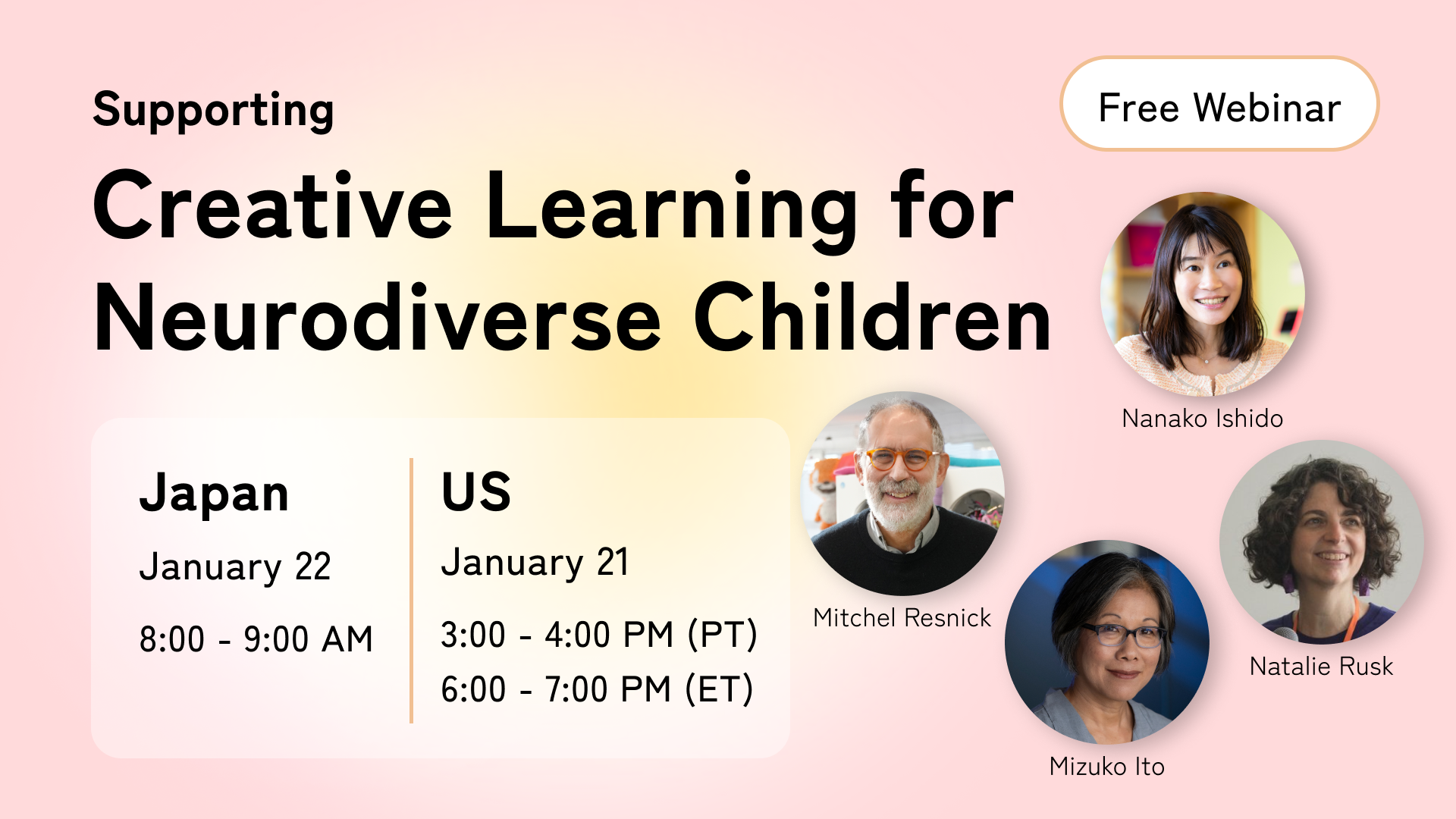
*English follows Japaneseニューロダイバースな子どもたちの創造的な学びを支える
渡辺ゆうか(慶應義塾大学SFC研究所 訪問研究員)
今回のウェビナーでは、創造的学習とニューロダイバーシティの接点について、多角的な議論が交わされました。米国からはMITメディアラボ 「ライフロング・キンダーガーテン(Lifelong Kindergarten,以下LLK)」のミッチェル・レズニックさんとナタリー・ラスクさん、日本からはニューロダイバーシティ運動を牽引する石戸奈々子さん。そしてモデレーターは、カリフォルニア大学アーバイン校コネクテッド・ラーニング・ラボ所長の伊藤瑞子(ミミ)教授です。
一見すると、創造的学習とニューロダイバーシティは別々のテーマのように見えるかもしれません。しかしセッションを通して浮かび上がってきたのは、「人を変えること」ではなく、「一人ひとりが力を発揮できる環境をどう設計するか」という問いを共有する登壇者たちの視点でした。
本稿は、2026年1月22日(日本時間1月23日)に開催された「ニューロダイバーシティ・ポテンシャル・スタディ・グループ(通称:NeuPoteKen)」第7回ウェビナーの対話とやりとりをもとに構成しています。
興味・関心に基づくクリエイティブ・ラーニングがニューロダイバーシティ・インクルージョンを支える
ミッチェルさんが率いるMITメディアラボの「ライフロング・キンダーガーテン」グループでは、長年にわたり、多様な背景を持つ子どもたちが創造性・好奇心・思いやり・協働といった力を育むクリエイティブ・ラーニングに参加できるよう、テクノロジーと学習体験の開発に取り組んできました。クリエイティブ・ラーニングが育まれるのは、子どもたちが自らの興味や情熱に基づくプロジェクトに取り組み、仲間と協力しながら遊び心を持って試行錯誤できる環境です。
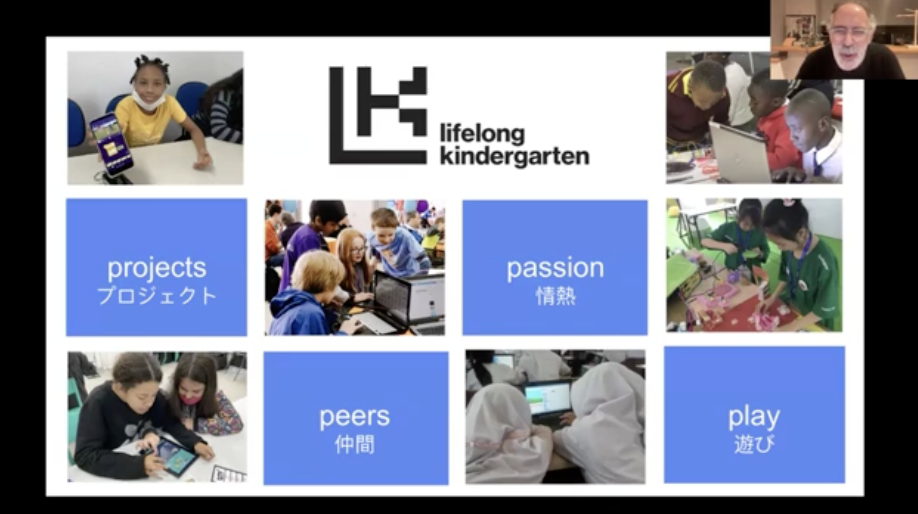
クリエイティブ・ラーニングを育む4つのP
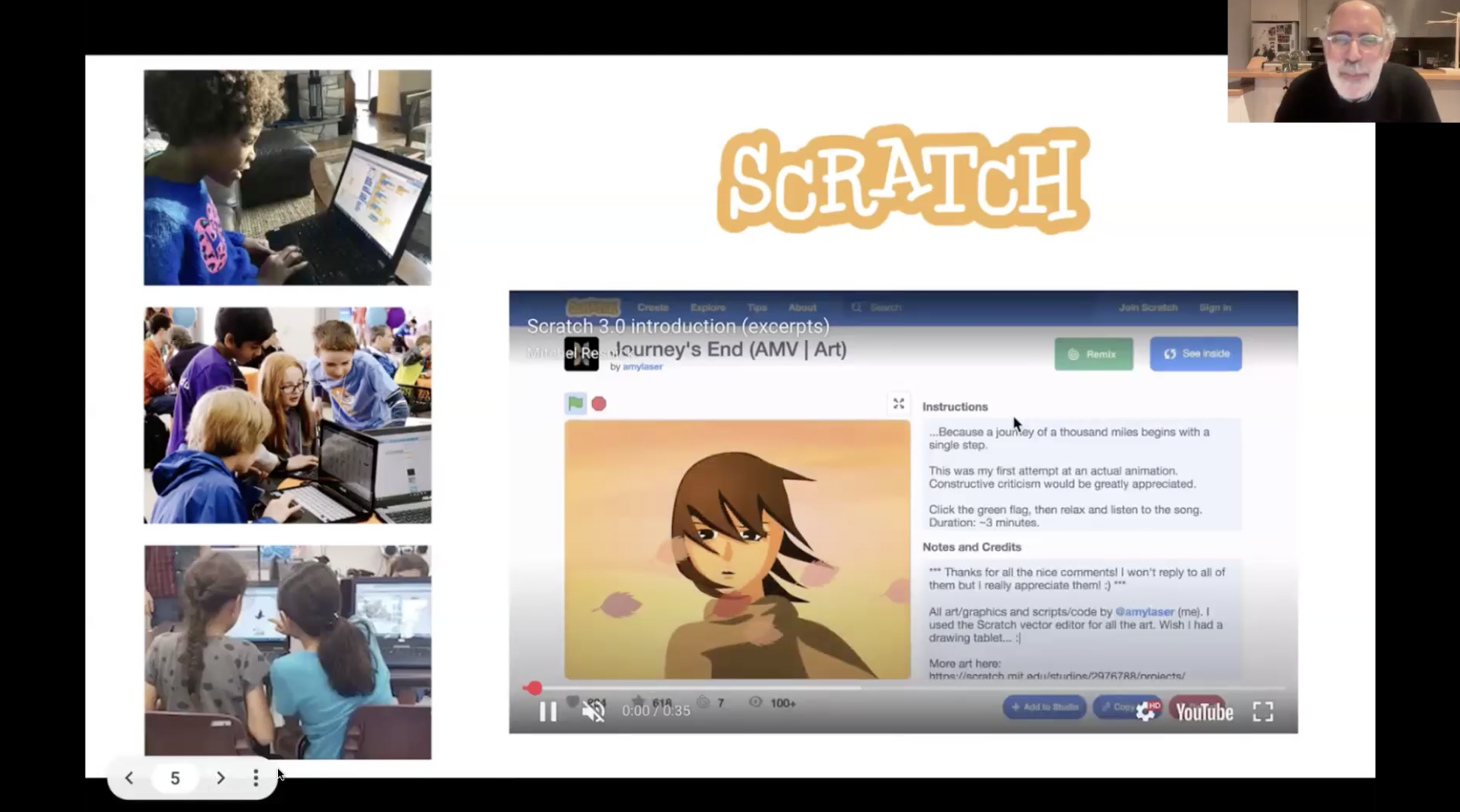
この理念に基づき、LLKはビジュアルプログラミング言語と、それを支えるオンラインプラットフォームおよびコミュニティを一体化したScratchを開発しました。2007年の公開以来、Scratchは世界中の1億5000万人以上の子どもたちが自分自身のプロジェクトを創り上げることを可能にしてきました。
Scratchはもともとニューロダイバーシティ・インクルージョンを特定の目的として設計されたわけではありませんが、多くのニューロダイバージェントなクリエイターを惹きつけてきました。
ミミさんは、これほど多くのニューロダイバージェントな子どもたちがScratchに引き寄せられる理由として、あらかじめ定められた学習目標ではなく、子ども自身の興味や関心に寄り添った探究を支える設計にあるのではないかと問いかけました。これに対し、ミッチェルさんはその考えに深く共感を示し、Scratchコミュニティでは、子どもたちの強い興味や深い情熱は制限として捉えられるのではなく、創造性の源として大切にされていると語りました。アニメーション、ビデオゲーム、マンガ、昆虫、電車など、どのような分野への関心であっても、その情熱が学びと創造の出発点になります。
Scratchは、そうした興味や関心を仲間と共有できる場を提供しているため、子どもたちは自分らしく参加することができます。こうした環境が、多様な背景や興味、思考スタイルを持つ子どもたちに「ここが自分の居場所だ」と感じられるコミュニティを育んできたと、ミッチェルさんは振り返りました。
さらにミッチェルさんは、自閉症のある11歳の男の子がScratchコミュニティに投稿した動画の言葉を紹介しました。
「もしみんなが同じだったら、世界はつまらない場所になってしまう。」
そして最後に、Scratchコミュニティの内外で多くの人々の共感を呼んできたメッセージで締めくくりました。
「You Be You.(あなたはあなたらしく。)」
この言葉は、一人ひとりが自分らしさを大切にし、そのままの自分を受け入れることの尊さをあらためて伝える、力強いメッセージとして参加者の心に響きました。

スクラッチを嬉しそうに紹介するミッチェルさん
続いてナタリーさんは、現在の多くの若者がモバイルデバイスを主なインターフェースとして利用している現状を踏まえ、OctoStudioを紹介しました。Scratchがデスクトップコンピュータ上で創造的な表現を支えてきたのに対し、OctoStudioは、モバイルデバイスに搭載されたさまざまなセンサーを活用することで、子どもたちの日常の環境そのものを創造の舞台へと変えていきます。モーションセンサーやデバイスの向き、デバイス同士の通信機能などを組み合わせることで、身の回りの世界を創造的な表現のメディアとして捉え、新しい作品や体験を生み出すことができると説明しました。
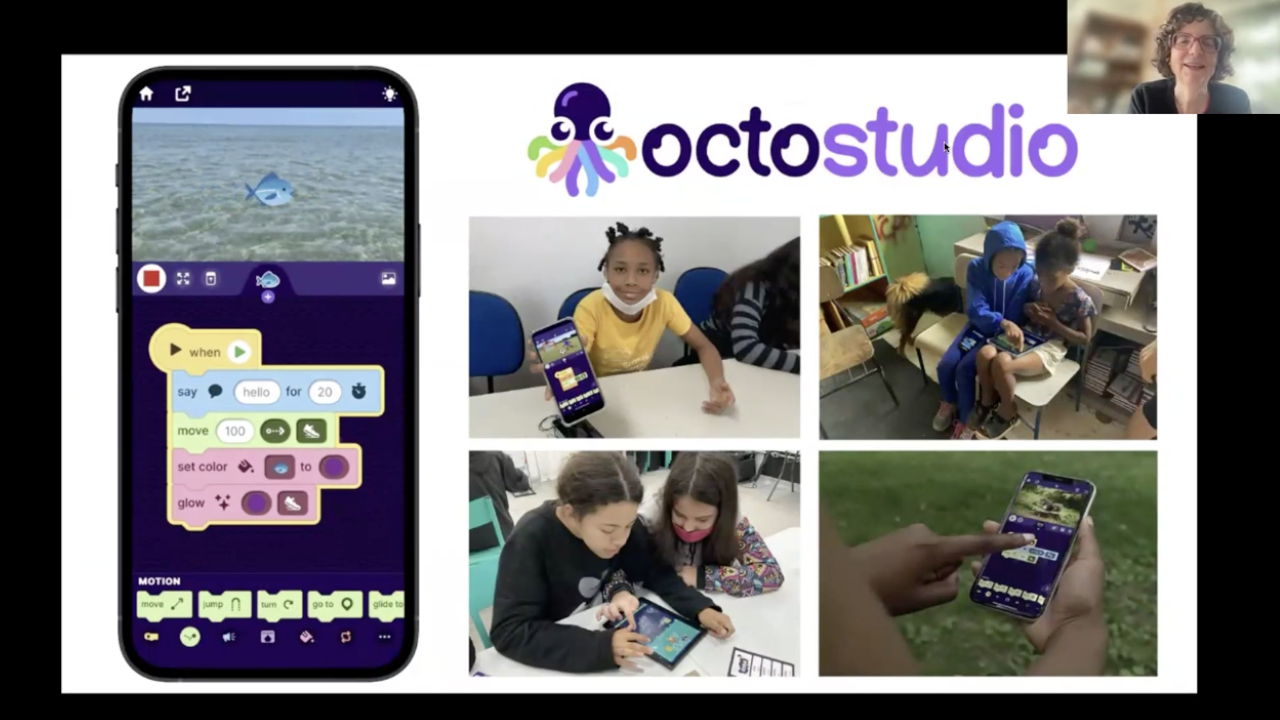
OctoStudioを用いた活動に取り組む子どもたち
デジタルコンテンツを消費するためのデバイスとしてではなく、OctoStudioはモバイルデバイスを「創るための道具」として捉え直します。子どもたちは、それぞれの興味や得意なこと、自分らしい学び方に合わせて、多様な形で創作活動に参加することができます。
ナタリーさんは、このアプローチの根底には、子どもたちが自由に試行錯誤できる文化があると語りました。OctoStudioでも同様に、「まずやってみる」ことが大切にされています。思いどおりにいかなければ修正し、ほかの人の作品から学びながら、自分のプロジェクトを少しずつ発展させていきます。
彼女は、このような学びのプロセスを「ティンカリング(tinkering)」と表現しました。ティンカリングとは、作り、試し、失敗し、また工夫を重ねることを通して学んでいく営みです。その試行錯誤の積み重ねこそが、子どもたちの創造性や主体性を育む重要な学びのプロセスであると強調しました。
OctoStudioを嬉しそうに紹介するナタリーさん
ナタリーさんは、LEGOブロックが子どものアイデアや興味を「間違い」と判断しないように、ScratchやOctoStudioも、子どもたちの興味やプロジェクトのアイデアを評価したり制限したりすることはないと語りました。むしろ、多様な興味の世界を自由に探究し、一人ひとりが自分に合ったペースや方法で創造を楽しめるようにつくられています。こうした設計思想は、学び方の違いや、一人ひとりが持つ情熱的な興味を尊重することにつながっています。それは、ニューロダイバーシティ・インクルージョンを実現するための重要な基盤でもあることが示されました。
「ワイド・ウォールズ」と選択肢を広げるという共通理念
ウェビナーの参加者が共有する中心的な目標であり課題のひとつは、多様な学習者が参加し、生き生きと活躍できる環境をつくることです。
ミッチェルさんは、効果的なクリエイティブ・ラーニング環境には、「ロー・フロア(参入しやすさ)」と「ハイ・シーリング(高度な創造への機会)」だけでなく、「ワイド・ウォールズ」、すなわち探究と表現のさまざまなパスウェイを支援することが求められると説明しました。そのような環境では、誰もが容易に取り組みを始められる一方で、学習者はそれぞれ独自の方法で幅広い興味を追求することができます。
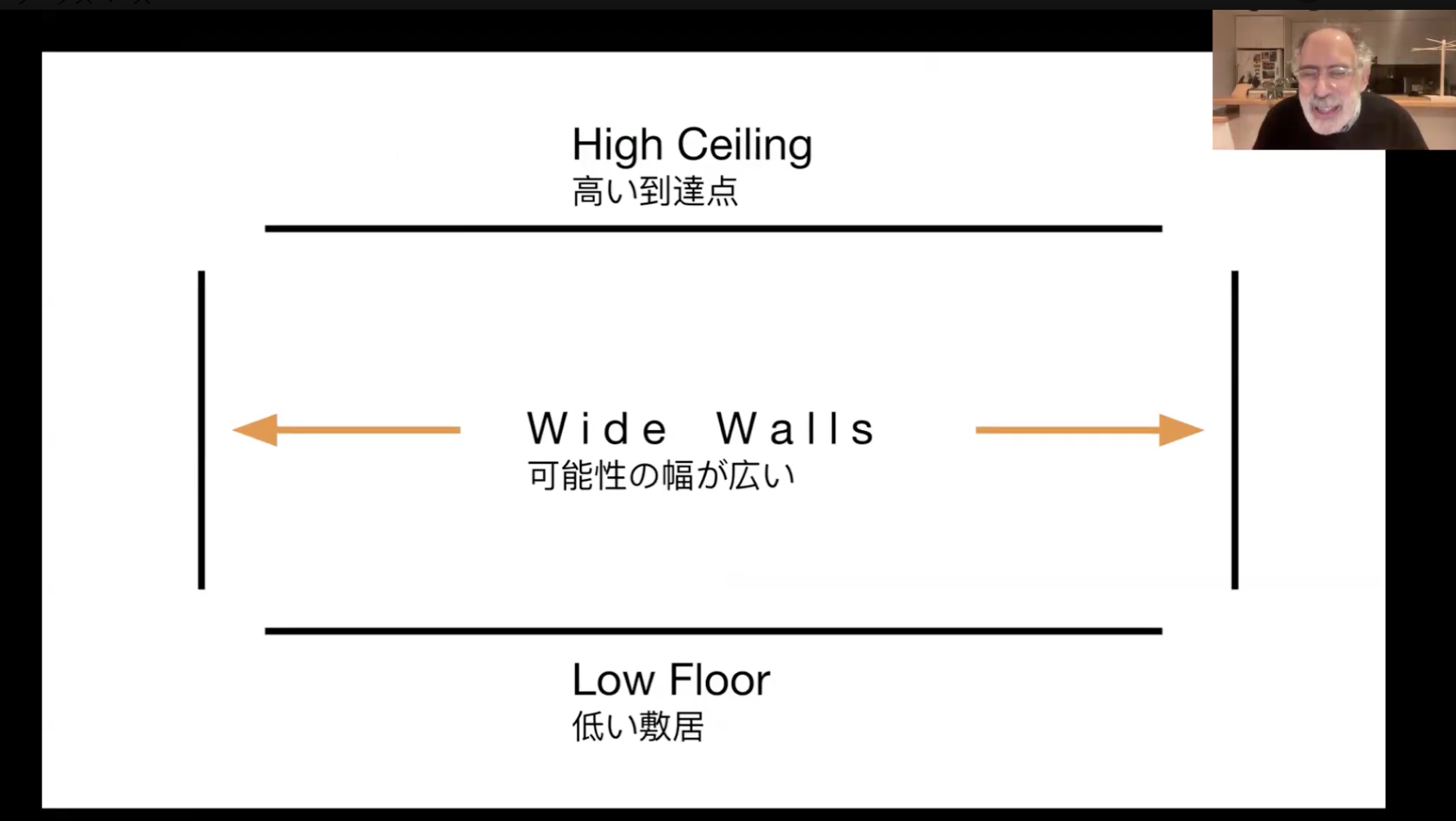
ワイド・ウォールズの考え方
この考え方に対し、石戸さんは、学習者は「何を学びたいか」「どのように学ぶことを好むか」「どのようなペースで学ぶか」のすべてにおいて一人ひとり異なると述べました。そして、Scratchがこうした多様性を設計の前提として受け入れ、全員に同じ学びの道筋を求めるのではなく、創り、共有し、つながるための柔軟な方法を提供している点を高く評価しました。
これを受けてミミさんは、多くのパーソナライズド・ラーニングのシステムが、学習ペースや学習の道筋を個々に最適化する一方で、その多くは標準化された学習成果へ導くことを目的としていると指摘しました。しかしScratchは、学ぶペースや方法だけでなく、「何を学ぶか」という選択そのものも学習者に委ねている点に特徴があると述べました。
石戸さんは、こうした理念を社会の中で実践する取り組みとして、「みんなの脳世界」をはじめとするさまざまなニューロダイバーシティ・プロジェクトを紹介しました。彼女が目指す「超多様性社会」とは、多様な認知スタイルや強みを持つ人々が、それぞれの力を生かしながら社会に参画できる社会です。そして、その実現を支える重要な役割をテクノロジーが担うと説明しました。
さらに、こうした実践は、テクノロジーが持つ大きな可能性も示しています。それは、一人ひとりの個性やニーズに応じた学びや支援を、これまでよりもはるかに低いコストで提供できるようになることです。かつては多くの人的資源を必要としていた個別支援も、テクノロジーを活用することで、より多くの人に届けられる可能性が広がっています。
この考え方は、LLKが提唱するクリエイティブ・ラーニングの理念とも深く響き合っています。目指しているのは、テクノロジーによってすべての人を一つの理想的な学び方へ導くことではありません。むしろ、多様な興味や強み、思考スタイルを持つ一人ひとりが、自分らしく学び、活躍できる環境を実現するために、選択肢を広げていくことにあります。それこそが、ニューロダイバーシティを包摂する社会の姿として、本ウェビナーを通して繰り返し共有されたメッセージでした。
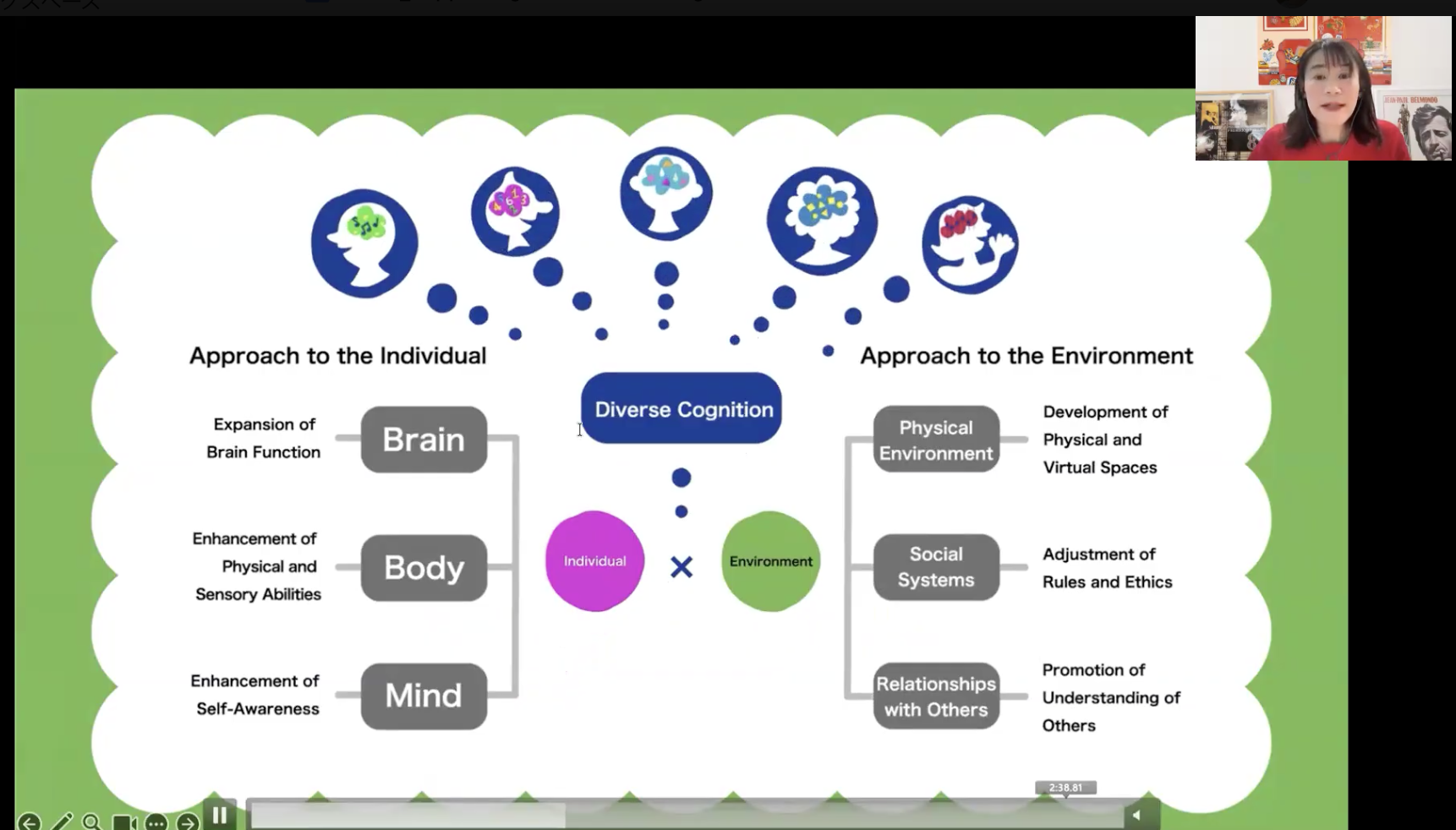
石戸さんが描く「超多様性社会」のビジョン
子どもたちの創造性と主体性を支えるテクノロジー
ウェビナーでは、テクノロジーの役割についても示唆に富む議論が交わされました。
ミッチェルさんは、重要な問いは「子どもたちはコンピュータについて何を学ぶべきか」ではなく、「子どもたちはコンピュータで何を創りたいか」であると強調しました。この考え方が、後にScratchの開発へとつながっています。また、人工知能をはじめとする新しいテクノロジーには新たなリスクも伴うと指摘しました。使い方によっては、子どもたちの選択肢や自律性、自己表現の機会を意図せず狭めてしまう可能性があります。だからこそ、子どもたちが自ら考え、自ら選び、自分のアイデアを表現し続けられる環境を守ることが何より重要だと語りました。
ナタリーさんも、AIの活用には慎重な視点が必要であると述べました。AIは過去のデータから抽出したパターンをもとに応答を生成するため、「平均的」あるいは予測可能な答えに収束しやすい傾向があります。そのため、AIに解決策を委ねるのではなく、子どもたち一人ひとりの興味や情熱、独自の表現を引き出し、広げるための道具として活用することが重要であるとの考えを示しました。
こうした議論を通して浮かび上がったのは、テクノロジーの価値は効率化や標準化にあるのではなく、一人ひとりの興味や可能性、多様な学び方や生き方を支えることにあるという視点です。だからこそ、本質的な問いは「人は何を学ぶべきか」ではなく、「何を創りたいのか」「何に心を動かされるのか」「世界とどのように関わりたいのか」へと変わっていきます。
多様性が花開く文化と文脈
石戸さんは、長年にわたり日本におけるデジタル教育の推進と、ニューロダイバーシティへの理解を広げる活動に取り組んできました。その原点の一つには、MITメディアラボでScratchをはじめとするクリエイティブ・ラーニングの実践に早くから触れた経験があると語りました。
さらに、クリエイティブ・ラーニングやコンピューティング教育の考え方が、日本の教育が抱えるさまざまな課題とどのようにつながっているのかについても言及しました。不登校の子どもたちの増加や、子どものウェルビーイングの低下といった現状を踏まえ、こうした課題は子ども一人ひとりの特性だけに原因があるのではなく、多様な認知特性と現在の学習環境との間に生じるミスマッチによって引き起こされている面があると述べました。
その上で、困難を抱える子どもを「困った子」ではなく「困っている子」と捉える視点への転換が重要であると強調しました。
この考え方は、ニューロダイバーシティの基本的な理念とも重なります。困難は個人の欠陥として捉えるものではなく、人と環境との関係の中で生じるものだという考え方です。ある環境では強みとして発揮される特性が、別の環境では困難として現れることもあります。だからこそ、個人を変えようとするのではなく、多様な人が力を発揮できる環境を整えることが重要であるという視点が共有されました。
日本の状況を語る石戸さん
この考え方を説明するために、石戸さんは「四角い車輪の自転車」という印象的な例えを紹介しました。舗装された滑らかな道では、丸い車輪が最も効率よく走ることができます。しかし、凸凹した不均一な地形では、四角い車輪の方がむしろ適しているかもしれません。
つまり、何が能力として発揮され、何が困難として現れるのかは、個人の特性だけで決まるものではありません。その人がどのような環境に置かれているかによって、その特性の意味や価値は大きく変わるのです。
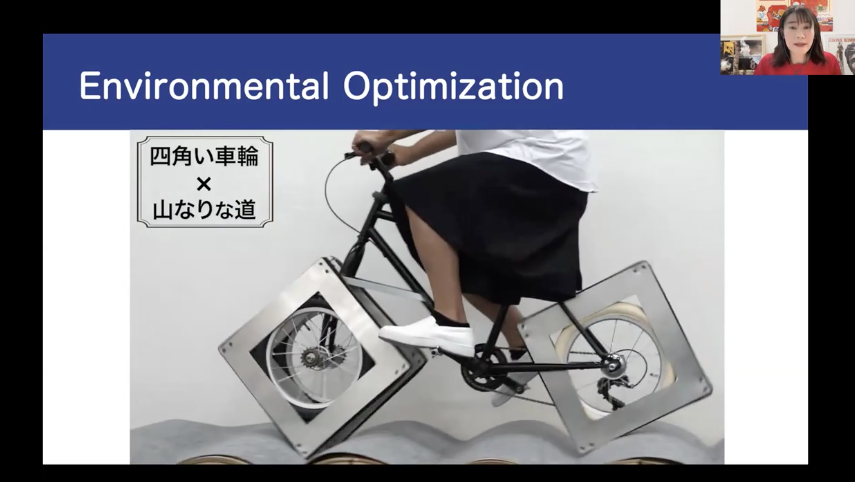
個人の特性と環境の関係性を示す例:四角い車輪の自転車
石戸さんは、日本におけるニューロダイバーシティの目標は、障害や個人差を補正して人々を「より普通に」することではないと強調しました。目指すのは、一人ひとりが自らの強みを生かし、自分らしく活躍できる環境をつくることです。一方で、日本社会は長年にわたり、同調性や集団への適応を重視してきました。学校教育においても、標準化されたカリキュラムや画一的な学び方が前提となることが多く、その枠組みに合わない子どもたちが力を発揮しにくい現実があります。
しかし、日本にはもう一つの文化的な側面もあります。アニメやビデオゲーム、オタク文化、そしてものづくりの文化に見られるように、強い興味や深い没頭、ひたむきな探究を価値あるものとして受け止める土壌が存在しています。ミミさんは、日本のアニメやゲームのコミュニティは、多様な興味やアイデンティティを持つ人々を受け入れた、世界でも初期のオンラインコミュニティの一つだったのではないかと述べました。
石戸さんは、日本には一見すると相反する二つの文化的価値観が共存していると指摘します。一つは同調を重んじる文化、もう一つは個性や情熱を尊重する文化です。こうした二つの伝統が併存しているからこそ、日本には欧米とは異なるニューロダイバーシティのあり方を切り拓く可能性があるのではないかと語りました。
本ウェビナーを通して示されたのは、「違い」を克服すべき課題として捉えるのではなく、学びや社会を豊かにする可能性として捉え直すという視点です。クリエイティブ・ラーニングとニューロダイバーシティの対話は、多様性を単に受け入れるだけでなく、一人ひとりの違いが創造性やイノベーション、新たなつながりを生み出す力となる社会の実現に向けた、大きな示唆を与えてくれました。
ニューロダイバーシティ・ポテンシャル・スタディ・グループ(NeuPoteKen)は、ニューロダイバーシティやコネクテッド・ラーニングに関心をもつ日英両言語圏の研究者・実践者・デザイナー・政策決定者のコミュニティです。本活動は、東京のNPO法人ニューロダイバーシティ、千葉工業大学変革センター、コネクテッド・ラーニング・ラボ、コネクテッド・ラーニング・アライアンス、金子総合研究室、一般社団法人国際STEM学習協会、ファブラボ鎌倉などの連携のもと運営されています。参加希望・お問い合わせは info@neupote.orgまでご連絡ください。
Supporting Creative Learning for Neurodiverse Children
Youka Watanabe (Visiting Researcher, Keio University SFC Research Institute)
This webinar explored the intersection of creative learning and neurodiversity through a wide-ranging discussion featuring leading voices from both Japan and the United States. The speakers included Mitchel Resnick and Natalie Rusk of the Lifelong Kindergarten Group at the MIT Media Lab, as well as Nanako Ishido, a leading advocate for the neurodiversity movement in Japan. The session was moderated by Professor Mizuko ("Mimi") Ito, Director of the Connected Learning Lab at the University of California, Irvine.
At first glance, creative learning and neurodiversity may appear to be separate topics. However, throughout the discussion, a common perspective emerged: rather than asking how to change people, the speakers focused on how to design environments in which every individual can thrive.
This article is based on the dialogue and discussions from the seventh webinar of the Neurodiversity Potential Study Group (NeuPoteKen), held on January 22, 2026 (January 23 in Japan).
Creative and Interest-Driven Learning Supports Neurodiversity Inclusion
For many years, the Lifelong Kindergarten Group (LLK) at the MIT Media Lab, led by Mitchel Resnick, has developed technologies and learning experiences that enable children from diverse backgrounds to participate in creative learning that develops creativity, curiosity, caring and collaboration. Creative learning is supported by environments where children can pursue projects driven by their own interests and passions, collaborate with peers, and engage in playful experimentation.
The Four Ps that Inspire Creative Learning
This philosophy led to LLK developing Scratch, an accessible visual programming language tied to an online platform and community. Since its release in 2007, Scratch has enabled more than 150 million children around the world to create their own projects. Scratch was not originally designed specifically for neurodiversity inclusion but it has attracted a large population of neurodivergent creators.
Mimi suggested that perhaps the reason so many neurodivergent children are drawn to Scratch is that it supports children pursuing their own interests rather than predefined learning objectives.
Mitchel agreed, explaining that within the Scratch community, children's intense interests and deep passions are celebrated as sources of creativity rather than viewed as limitations. Whether their interests lie in animation, video games, manga, insects, trains, or countless other topics, these passions become starting points for learning and creative expression.
Because Scratch provides a platform where children can share these interests with others, they are able to participate as their authentic selves. This, he explained, has helped foster a welcoming community where children with diverse backgrounds, interests, and ways of thinking can feel a sense of belonging.
Mitchel also shared the words of an eleven-year-old boy with autism from a video he had created and posted in the Scratch community:
"If everyone were the same, the world would be a boring place."
The boy concluded with a message that resonated deeply within the Scratch community and beyond:
"You Be You."
His words became a powerful reminder that one of the most important things in life is to embrace who you are.
Mitchel Resnick introducing Scratch
Natalie then introduced OctoStudio, a project designed to extend the possibilities of Scratch by responding to the reality that many young people today interact primarily through mobile devices.
Whereas Scratch expanded opportunities for creative expression on desktop computers, OctoStudio brings creativity into children's everyday physical environments by taking advantage of the sensors built into mobile devices. Using features such as motion, device orientation, and communication between devices, children can transform the world around them into a medium for creative expression.
OctoStudio and Children Engaging in Creative Activities
Rather than serving simply as a device for consuming digital content, OctoStudio reimagines the mobile device as a tool for creation. It supports a wide range of ways for children to participate based on their individual interests, strengths, and ways of learning.
Natalie explained that this approach is rooted in a culture that encourages children to freely experiment. In Scratch, learners are invited to try things for themselves. If something does not work as expected, they revise it, learn from others' projects, and continue improving their own. She described this process as "tinkering"—learning by making, experimenting, and iterating.
Natalie Rusk Introducing OctoStudio
Just as LEGO bricks never tell children that their ideas or interests are "wrong," the Scratch and OctoStudio platforms do not judge or limit interests and project ideas. Instead, it encourages exploration and creation in diverse areas of interest, and at the pace and depth that works for individual creators. These are all features that support neurodiversity inclusion by accommodating learning differences and in-depth pursuit of passionate interests.
“Wide Walls” and Expanding Choice: A Shared Philosophy
One of the central goals and challenges shared by the webinar participants is to create environments in which diverse learners can participate and thrive.
Mitchel explained that an effective creative learning environment requires not only a Low Floor (easy entry) and a High Ceiling (opportunities for sophisticated creation), but also Wide Walls—support for many different pathways for exploration and expression. Such an environment allows anyone to get started easily while enabling learners to pursue a wide variety of interests in their own unique ways.
The Concept of Wide Walls
Echoing this perspective, Nanako noted that every learner differs in what they want to learn, how they prefer to learn, and the pace at which they learn. She praised Scratch for embracing these differences by design, offering flexible ways for learners to create, share, and connect with one another without requiring everyone to follow the same path.
Mimi pointed out that many personalized learning systems focus primarily on optimizing learning pace or instructional pathways to standardized academic outcomes. Scratch, however, supports personalization not only in pace and pathways, but in how and what they choose to learn.
Guided by a similar vision, Nanako has organized a variety of neurodiversity initiatives, including Everyone's Brain World (Minna no Nou Sekai), with the goal of realizing what she describes as a "super-diverse society." These initiatives showcase how people with diverse cognitive styles and strengths can participate fully in society by building on their individual abilities, and technologies that can support this.
These initiatives highlight one of technology's greatest potentials: its ability to provide personalized learning and support at much lower cost than ever before. Opportunities that once required significant human resources can increasingly be delivered through technology in ways that accommodate each person's unique characteristics and needs.
This vision closely resonates with the philosophy of creative learning advocated by LLK. The goal is not to use technology to move everyone toward a single ideal way of learning or being. Rather, it is to expand the range of choices available so that people with different interests, strengths, and ways of thinking can flourish in a neurodiversity inclusive environment.
Ishido's Vision for a Super-Diverse Society
Technology in Support of Children’s Creativity and Agency
The webinar also featured a thought-provoking discussion about the role of technology.
Mitchel emphasized that the important question is not "What should children learn about computers?" but rather "What do children want to create with computers?" This philosophy ultimately led to the development of Scratch.
He cautioned that emerging technologies like artificial intelligence carry new risks. Depending on how they are used, they may unintentionally limit children's choices, autonomy, and opportunities for self-expression. What matters most, he argued, is ensuring that children continue to have opportunities to think for themselves, make their own choices, and express their own ideas.
Natalie shared a similar concern. Because AI often generates responses based on patterns extracted from past data, it tends to produce "average" or expected answers. Rather than relying on AI for solutions, she argued that it should be used in ways that support children's own interests, passions, and unique forms of expression.
Taken together, the discussion suggested that the value of technology lies not in efficiency or standardization, but in its ability to support each person's interests, potential, and diverse ways of learning and living. The essential questions are therefore not, "What should people learn?" but rather, "What do they want to create?" "What captures their curiosity?" and "How do they want to engage with the world?"
Culture and Contexts Where Diversity Can Thrive
Nanako has long worked to promote digital education and greater understanding of neurodiversity in Japan. She explained that one of the inspirations behind her work was her early encounter with creative learning initiatives at the MIT Media Lab, including Scratch.
She spoke to the ways in which creative learning and computing initiatives have intersected with broader structural issues in Japanese education. She has witnessed growing challenges, including increasing numbers of students who are absent from school and declining levels of children's well-being. She sees these problems as tied not only to characteristics of individual children, but to a mismatch between diverse neurological traits and existing learning environments.
She emphasized the importance of shifting our perspective—from seeing children who struggle as “difficult children” to recognizing them as “children in difficulty.”
This perspective reflects a core principle of neurodiversity: challenges should not be understood as deficits residing within individuals, but as outcomes that emerge through the interaction between people and their environments. A trait that functions as a strength in one context may become a challenge in another.
Nanako Ishido Discussing the Situation in Japan
To illustrate this idea, she introduced the memorable example of a bicycle with square wheels. On a smooth road, round wheels perform best. On rough or uneven terrain, however, square wheels may actually be more effective. What counts as an ability or a disability therefore depends not solely on the individual, but on the environment in which that individual is situated.
A Memorable Illustration of the Relationship Between Individual Traits and Environment: The Bicycle with Square Wheels
She emphasized that the goal of neurodiversity in Japan is not to compensate for disabilities or individual differences in order to make people "more normal." Rather, it is to create environments in which each person can express their strengths and thrive as their authentic selves. Japanese society has long placed a strong emphasis on conformity and fitting in with the group. In schools, standardized curricula and uniform approaches to learning are often taken for granted, making it difficult for children who do not fit existing expectations to thrive.
At the same time, however, Japan has another cultural tradition. As seen in anime, video games, otaku culture, and craftsmanship, there is a deep-rooted appreciation for people who develop intense interests, immerse themselves deeply in a subject, and pursue it with unwavering dedication. Mimi noted that Japan's anime and gaming communities may have been among the first online communities in the world to embrace people with diverse interests and identities. Nanako pointed out that two seemingly contrasting cultural values coexist in Japan: one that encourages conformity and another that celebrates individuality. Precisely because both traditions exist side by side, Japan may have the opportunity to develop approaches to neurodiversity that differ from those emerging in Western countries.
Rather than viewing differences as problems to be overcome, the discussion encouraged us to see them as sources of possibility that can enrich both learning and society. The dialogue between creative learning and neurodiversity offers an important lens through which to imagine a future where diversity is not merely accommodated, but embraced as a foundation for innovation, participation, and human flourishing.
The Neurodiversity Potential Study Group (NeuPoteKen) is a community of researchers, practitioners, designers, and policy makers interested in cross-cultural dialogue between Japanese and English-speaking communities on topics related to neurodiversity and connected learning. It is part of an ongoing collaboration between the Neurodiversity NPO in Tokyo, Center for Radical Transformation at Chiba Tech, Connected Learning Lab, Connected Learning Alliance, Kaneko Lab, Global STEM Learning Association Japan and FabLab Kamakura. Please email info@neupote.org to inquire about joining NeuPoteKen.