行動療法から学びのためのユニバーサルデザインへ ― ニューロダイバーシティを尊重したセラピーと特別支援教育 / From Behavioral Training to Universal Design for Learning – Embracing Neurodiversity in Therapy and Special Education

*English follows Japanese
行動療法から学びのためのユニバーサルデザインへ ― ニューロダイバーシティを尊重したセラピーと特別支援教育
岡部大介(東京都市大学メディア情報学部教授)
2025年9月23日(日本時間9月24日)、ニューロダイバーシティ・ポテンシャル研究会(NeuPoteKen)の第4回ウェビナーが開催され、日本およびイギリスから、ニューロダイバーシティと学習を専門とする二人の専門家――東京学芸大学の藤野博教授と、発達心理学者のジェイミー・ガルピン博士――を迎えました。このウェビナーでは、ニューロダイバージェントな子どもたちの治療的、そして学習的なニーズに加えて、日本とイギリスにおいてみられる学校の文脈、環境、プログラム、教育的支援、そして研修の実践について議論しました。モデレータは、カリフォルニア大学アーバイン校コネクテッド・ラーニング・ラボ所長の伊藤瑞子(ミミ)教授です。
本稿は、第4回ウェビナー「From Behavioral Training to Universal Design for Learning(行動療法から学びのためのユニバーサルデザインへ)」での対話をもとに構成しています。
スキルから遊びへ
藤野さんの専門はコミュニケーション障害で、日本における「心の理論」研究を代表する研究者のおひとりです。彼はまず、自閉スペクトラム症のある子どもたちの社会的相互行為と学習に関するご自身の研究的な視点が、これまでの長年の研究を通じてどのように変化してきたのかについて話しました。
藤野さんが当初採用していたパラダイムでは、「目標となる特定のスキルを達成すること」がプログラムの目的となっていました。しかし次第に、「スキル」を目的そのものとするのではなく、遊びの副産物として捉える見方へと転換していきました。この重要な転換を示すために、藤野さんは自閉スペクトラム症と診断された8歳の女児の事例を紹介してくれました。
その女の子は、「友だち関係を築くこと」に困難を抱えていて、「相手の発言について質問する」といった「会話の順番交替」に焦点を当てたソーシャル・スキル・トレーニング(SST)が計画されていました。トレーニングが進むにつれて、表面的な指標としては改善が見られるようになり、たとえば、彼女は相手の話を聞く際に、以前よりも頻繁に相手の方を見るようになりました。コミュニケーションとしては、一見すると向上したように見えたそうです。しかし藤野さんは「まるで彼女がインタビュアーになってしまったかのようだった」と実際のところ感じたといいます。彼女は「質問を次々と投げかけ続け」、藤野さんには、「会話は成立しているものの、あまりプレイフルには感じられなかった」と映ったようです。
このような経験を通して、藤野さんの考え方は次第に変化していきました。すなわち、「子どもたちの特性を機能的欠損として見るのではなく、中立的に、もしくは肯定的に捉え直し、それらの特性を活かして子どもを支援する」方向へとシフトしたそうです。この転換のひとつとして、会話の機会をつくる際に、藤野さんは「会話そのものを楽しいものにする」活動として、テーブルトーク・ロールプレイング・ゲーム(TRPG)などを検討するようになりました。
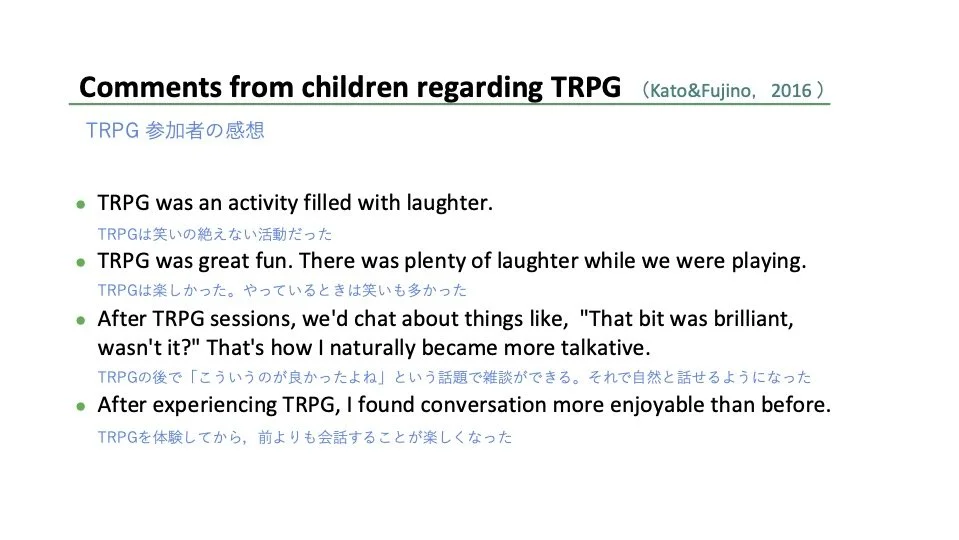
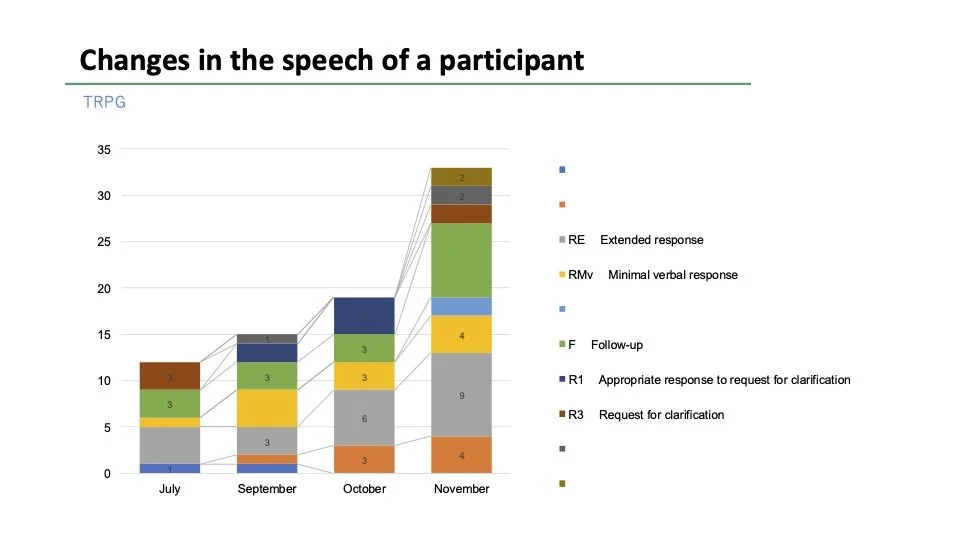
藤野さんの共同研究者である加藤浩平さんが中心となって行っているTRPG活動では、子どもたちが物語を共同で紡ぎながら、自然な会話を楽しむ様子が観察されています。参加したある子どもは、「拡張された応答」(相手が言ったことに対してさらに話題を広げて返す)や「フォローアップ」(相手のだした話題を続けていく)といった会話スキルが大きく改善しました。何より重要なのは、参加した子どもたちが「とても楽しかった」「この活動を通じて会話ができるようになった。会話が楽しくなった」と語っていることです。
一方で藤野先生は、学校の特別支援学級の中でこのような遊びに根ざした経験の場をつくることには困難が伴うとも述べています。そのため彼のチームは、主に、学校外の「サードプレイス」で活動を行ってきました。ただし、日本の「通級」の制度には一定の可能性を見出しているともいいます。通級とは、子どもが通常の学級を離れ、定期的に学校内の別の教室で指導を受ける制度です。
通級における指導の内容は、主に「自立活動」と呼ばれるカリキュラムから構成されています。このカリキュラムは教科学習そのものではなく、比較的柔軟性が高いことから、子どもの自立を促すことを目的とした多様な活動をしやすくするものです。藤野さんのチームは、学校から招かれて、通級における自立活動や、障害のある子どもたちを対象とした放課後等デイサービスにおいてTRPGを実施してきました。
多様性のなかのユニティ(Unity in Diversity)
ジェイミーさんは、インクルージョン、イノベーション、学習デザインを専門とする発達心理学者であり、教育機関、産業界、テクノロジー・デザイナーに対して幅広いコンサルティングを行っています。その中には、東京のニューロダイバーシティ・スクール・イン 東京(Neurodiversity School in Tokyo:NSIT)も含まれます。
学校と協働する際、ジェイミーさんは必ず、エドガー・モランによる1999年の次の言葉から話を始めるといいます。
「『人間とは何か』を理解するとは、多様性のなかのユニティ(Unity: 団結)、ユニティのなかの多様性を理解することである。教育は、あらゆる領域においてこのユニティ/多様性の原理を示すべきである。」
この言葉はもともと教育の未来について述べられたものですが、「人間であるとはどういうことか」を理解するうえで2つの重要な点を示しています。すなわち「私たちの多様性を認識すること」と、同時に「私たちのユニティ」、すなわち私たちすべてに共通するものを理解することです。この両方を等しく保ち、どちらかが他方を覆い隠さないようにすることが求められます。
発達科学や自閉症研究の分野では、違いに多くの焦点が当てられてきており、それがユニティを覆い隠してきたかもしれません。しかも、こうした違いの多くは「修正されるべきもの」として捉えられてきました。何かに強い情熱をもつことは、「強み」ではなく「欠けているもの」と見なされがちです。遊びは、ユニティ(誰もがする)と多様性(遊び方はさまざまである)の好例ですが、「何が欠けているか」を診断するための文脈として用いられてきました。自閉スペクトラム症のある子どもたちの「遊び」は、「同じことを繰り返す(反復的)」、「限られたことしかしない(限定的)」という理由から、「正しい遊び方ではない」と評価されてきました。またADHDのある子どもたちの「遊び」も同様に、診断的な視点から「注意散漫で、まとまりがない」と捉えられてきました。
そこでジェイミーさんは、学校に対し、多様性だけでなくユニティ、すなわち「私たちすべてに共通するもの」にも目を向けるよう促します。それは何でしょうか。それは、普遍的な困難、とりわけ誰もが経験する「不確実性への困難さ」のことを指します。私たちの脳は、「予期しない出来事」や「何が起こるかわからない状況」をなるべく抑えようとします。私たちは不確実性を管理しようとし、不確実性が圧倒的になった場合は、自然と回避しようとする。この反応は、ニューロダイバージェントかどうかにかかわらず、誰もが共感できるものです。不確実性から逃れるために、私たちは知識かエージェンシー(主体性・コントロール)という2つのうちのどちらかに手を伸ばします。
そして、これまで「問題行動」とラベルが貼られてきた多くの行動は、ジェイミーさんのチームによれば、「実際には、不確実性に対処しなければならないことから生じる、コントロールへの欲求が強く表出したもの」にすぎません。このように捉え直すならば、その行動は「問題」ではなく、不確実性に対する適応的な反応、コントロールへの過度な欲求です。
学習のためのユニバーサルデザイン(UDL:Universal Design for Learning)と失敗コストの低い学習空間
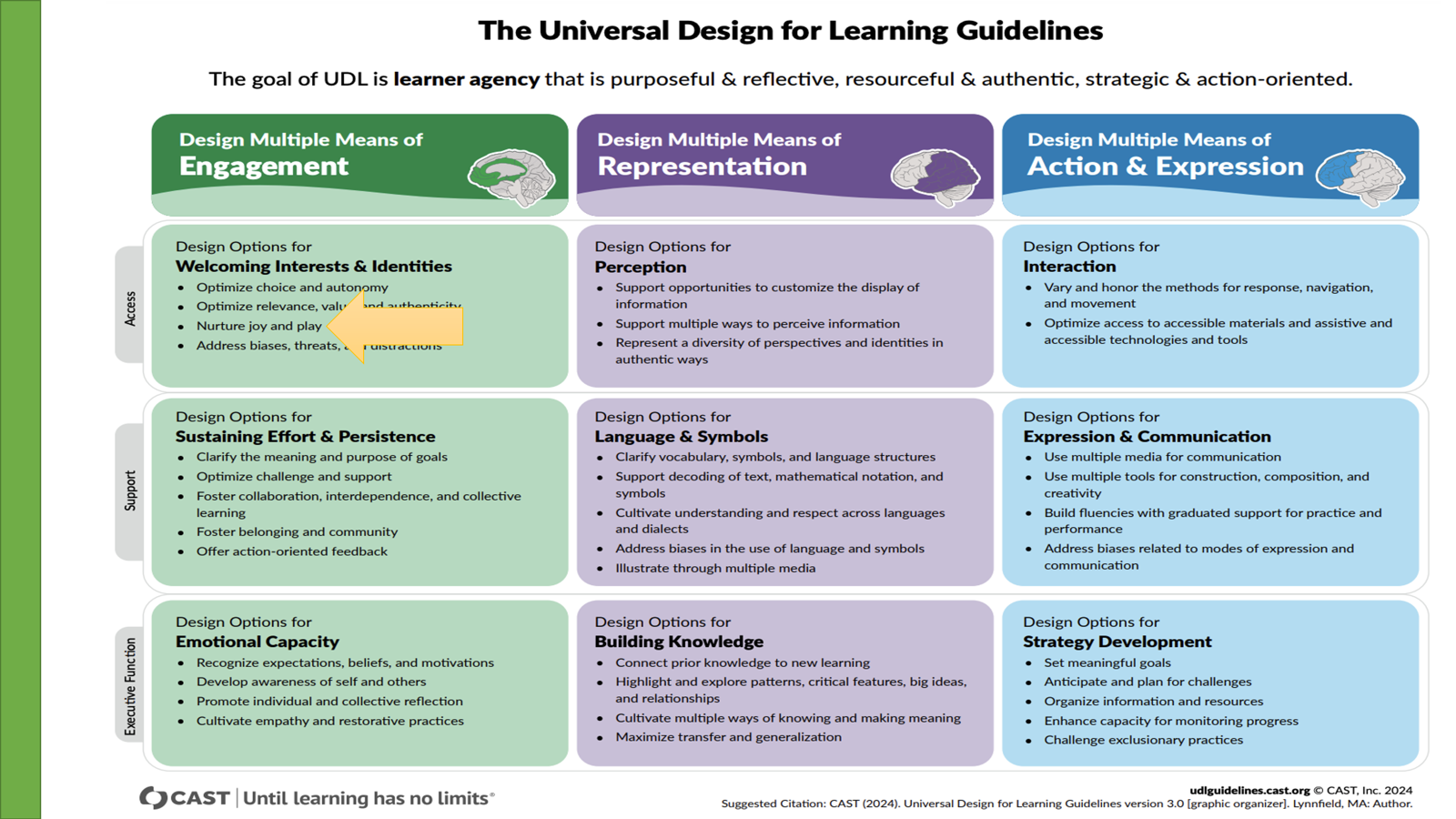
ジェイミーさんは、UDL(ユニバーサル・デザイン・フォー・ラーニング)のアプローチと藤野さんが紹介したTRPGクラブには、多くの共通点があると見ています。UDLのアプローチは、「誰もがみんな異なっている」という前提から出発します。そして、環境に合わせて人の方を変えるのではなく、多様性を包摂するように環境を変えることに焦点を当てます。「もっとも周縁化されがちな人たちや、端におかれがちな人たちのためにデザインすれば、結果的に、誰にとっても本当によく機能するものをつくることができる」。ジェイミーさんは次のようにもいいます。「長いあいだ、わたしたちは、実在しない『平均的な人』のためにデザインしてきた。『平均のためにデザインするということ』は、誰のためにもデザインしていないということです。だからわたしたちは、まずはその前提を解体する作業を重ねています。」
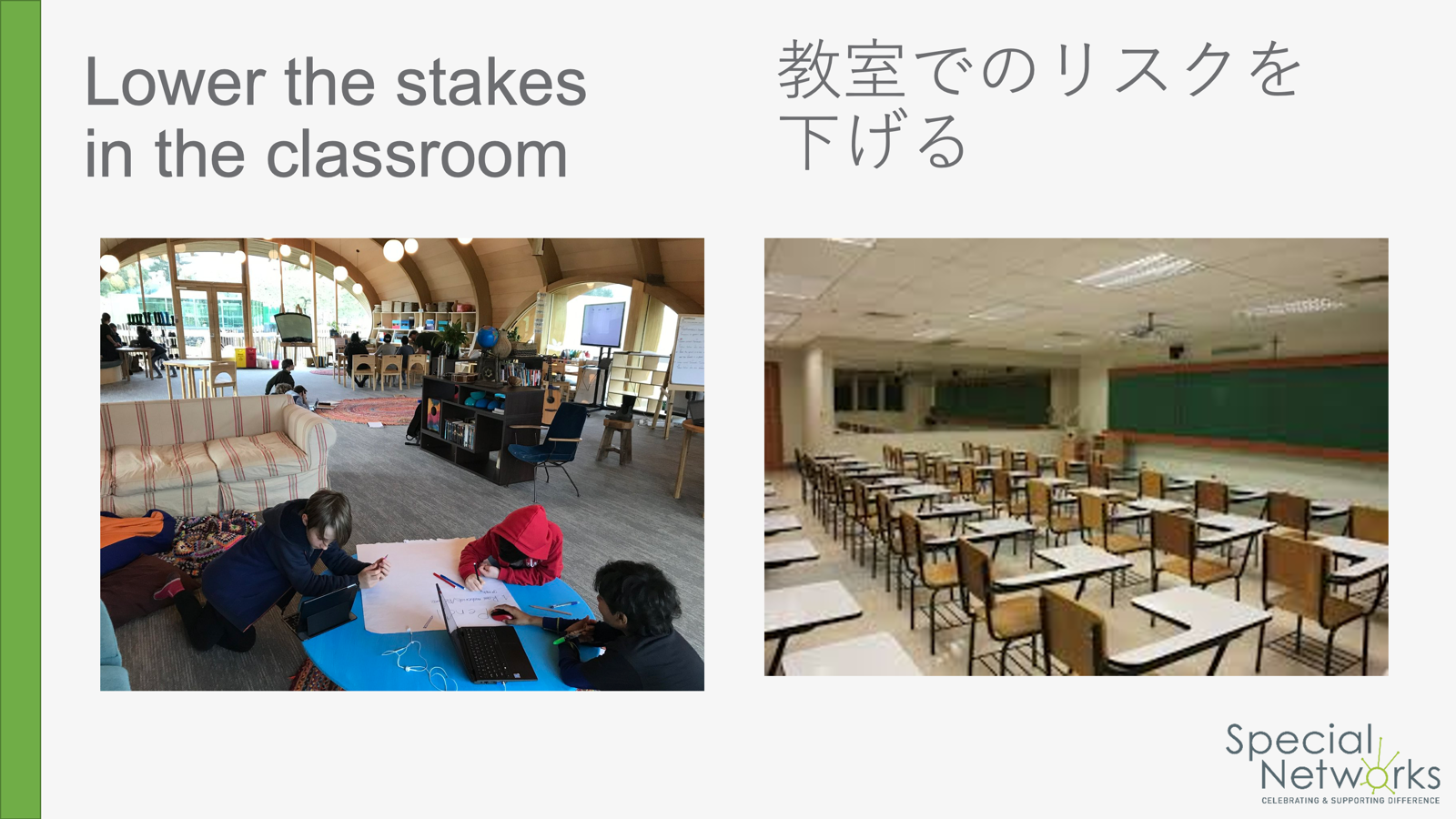
ジェイミーさんは、従来型の教室と、よりインクルーシブに設計された教室との違いを示す視覚的な例を共有しました。従来型の教室では、すべての子どもが机に座り、前方を向くという、画一的な設計になっています。一方、個々の違いを受け入れる教室には、さまざまな座席の選択肢があります。低い椅子、立って使える机、ハンモック、異なる種類の照明など、さまざまな学習の好みに対応する空間が用意されています。そして重要なのは、従来型の緊張感の高い学習環境とは対照的に、失敗コストが低いと感じられる雰囲気を醸し出す空間である点です。
このような環境だと、子どもたちは周囲を見渡して、「みんなが少しずつ違うやり方で学んでいる」ことに気づくことができます。「特別扱いされているのが自分だけではない」という感覚が生まれ、違いに対するスティグマも軽減されます。環境デザインは、学習の失敗コストを下げるだけでなく、「違っていても大丈夫だ」というメッセージを即座に伝える力をもっていると、ジェイミーさんは話します。柔軟な教室空間は、ユニティと多様性の原理を体現するものです。
ジェイミーさんにとって、学校とは「間違うために行く場所」であるべきだといいます。学校は、本来的に、失敗してもよい場所であるべきなのです。その意味で、学校は人生を練習するための、失敗コストの低い空間であるべきであり、その意味で遊び心あふれる空間であるべきだとジェイミーさんは考えています。遊びとは、失敗コストの高い課題を練習するための、失敗コストの低い機会である、とも言えるとジェイミーさんは言います。しかしながら、少なくともイギリスにおいては、「学校は失敗コストの高い場所」になってしまっているようです。
そのためジェイミーさんのチームは、藤野さんのチームと同様に、学校のなかに遊びの概念をどのように持ち込めるかを模索しています。すぐさま一気にゲームを導入するのではなく、人びとが安全にリスクを取ることのできる空間、すなわち「ちょうどよい程度の不確実性」を組み込むのです。ジェイミーさんのチームは学校に対して、「リスクを下げ、失敗を愛そう」と伝えているそうです。
遊びは本質的に不確実性を含んでいますが、それは適度な不確実性です。藤野さんが紹介したTRPGには、予測不可能な結果が組み込まれており、不確実性と常に共存しています。遊びのなかでは、「わたしたちは、自分のコントロールできない状態を、自分でコントロールしている」のです。そしてジェイミーさんは、遊びは「失敗コストが低い」ことを強調します。たとえばTRPGでは、日常生活では非常に失敗コストが高く感じられる社会的相互行為に関わるスキルを、より失敗コストの低い形で経験することができるのです。
多様性の中に共通性(Commonality)を見いだすこと
UDLのトピックのあと、プロジェクト型学習を実践しているファブラボ鎌倉の渡辺ゆうかさんから、現場に根ざした実践的な問いが投げかけられました。「多様性を支えつつ、子どもたちの楽しさを持続させたいと考えたとき、実際にはどれほどの人員の配置や支援が必要になるのでしょうか」という問いです。渡辺さんは、個別的な支援は、結果としてほぼ1対1に近い関わりを必要とする場合があること、そして6歳から8歳という年齢の子どもは、とりわけいろいろな対応の難しさのある時期であることに言及しました。そのうえで、イギリスではどのような支援体制が存在しているのかを質問しました。
この質問に対してジェイミーさんは、診断へのアクセスはすべての人に平等に開かれているわけではないと回答しました。そのうえで、自身のチームでは「診断が必要である」という「文化」からいったん離れ、「ニーズを診断する」方向へとシフトしようとしていると説明しました。重要なのは、その人がどのような診断を受けているか、あるいはどのように自己を定義しているかにかかわらず、「『個としての目の前のこの人』には何が必要なのか」を問うことだというのです。そして、そのニーズに応えるために、どのような支援を整えることができるのかを考えるべきだと述べました。
ここで再び重要になるのが、「ユニバーサルなもの」という視点です。程度の差はあれ、誰もが不確実性への困難を抱えています。そうであれば、その不確実性に対処するための支援を用意することはできないでしょうか。たとえば、共通の関心に基づき、失敗コストの低い環境のなかで一緒に遊ぶ機会をより多くつくることはできないでしょうか。藤野さんが共有した研究が示すように、私たちが育みたいのは「共有された理解」であり、共有された関心は、それを可能にする結びつきを生み出す助けになります。
藤野さんは、日本の特別支援教育制度が、もともとはイギリスの影響を受けてデザインされたものであることにも言及しました。日本においても、自閉症のある子どもたちの関心は「特殊なもので限定されたもの」や「病理的なもの」として捉えられてきた歴史があります。そして、比較的最近になってようやく、より中立的な表現として「特別な関心(special interest)」という言葉が使われるようになってきました。これに対してジェイミーさんは、すべての子どもが共感できる言葉として「特別な関心」ではなく「パッション(情熱)」という言葉を使うべきだと提唱してきた人たちがいることに触れました。藤野さんもこの発想を高く評価しています。「特別」という言葉を使うことは、どうしても「分断」を生み、「特別な子どもたち」という物語をつくってしまいかねません。
最後に、モデレータのミミさんは次のようにまとめました。今回の対話では、「私たちはユニティ、多様性、そして違いをどのように語るのか」という問いが探究されました。同時に、それらを価値づけ、より創造的で開かれた空間をつくろうとする試みが、現実世界のさまざまな課題に直面することも確認されました。
こうした課題は、対象となる個人の周縁化や病理化に基づくアプローチではなく、よりユニバーサルなアプローチを構想し、その理想を吟味し洗練させていく過程において、必然的に立ち現れてくる、非常に重要なものです。おふたりの登壇者による専門的な実践と知見のおかげで、私たちはこの点を深く認識することができました。
ニューロダイバーシティ・ポテンシャル・スタディ・グループ(NeuPoteKen)は、ニューロダイバーシティやコネクテッド・ラーニングに関心をもつ日英両言語圏の研究者・実践者・デザイナー・政策決定者のコミュニティです。本活動は、東京のNPO法人ニューロダイバーシティ、千葉工業大学変革センター、コネクテッド・ラーニング・ラボ、コネクテッド・ラーニング・アライアンス、金子総合研究室、一般社団法人国際STEM学習協会、ファブラボ鎌倉などの連携のもと運営されています。参加希望・お問い合わせは info@neupote.orgまでご連絡ください。
From Behavioral Training to Universal Design for Learning – Embracing Neurodiversity in Therapy and Special Education
Daisuke Okabe (Professor in Sociology and Media Studies and Informatics at Tokyo City University)
On September 23, 2025 (September 24, Japan time), the fourth webinar of the Neurodiversity Potential Study Group (NeuPoteKen) welcomed two experts in neurodiversity and learning from Japan and the United Kingdom, Professor Hiroshi Fujino of Tokyo Gakugei University and developmental psychologist Dr. Jamie Galpin. We discussed the therapeutic and learning needs of neurodivergent children, as well as the contexts, environments, programs, educational support, and training happening in Japan and the UK. The moderator was Professor Mizuko “Mimi” Ito, Director of the Connected Learning Lab at the University of California, Irvine.
This essay is based on the dialogue from our fourth webinar, "From Behavioral Training to Universal Design for Learning."
From Skills to Play
Hiroshi is a specialist in communication disorders and is one of Japan's preeminent scholars in theory of mind research. He started by describing how his research perspective on social interaction and learning for autistic children shifted through the course of his many years of research
In the paradigm that he initially adopted, "achieving specific target skills was the purpose of the program." He shifted his view towards seeing skills as a byproduct of play. To illustrate this crucial shift, Hiroshi introduced the case of an 8-year-old girl diagnosed with autism spectrum disorder.
She struggled to "build friendships," so a social skills training (SST) plan was developed focusing on conversational turn-taking, such as "asking questions about what the other person said." As the training progressed, surface-level metrics showed improvement—she looked at her conversation partner more often while listening. Communication appeared to improve. But in reality, Hiroshi felt "it was like she had become an interviewer." She kept "asking question after question," and to Hiroshi, "even though they were having a conversation, it didn't feel very playful."
Through experiences like this, Hiroshi gradually shifted his thinking: "Rather than viewing children's tokusei as functional deficits, I began to reframe them neutrally or positively, and to leverage those characteristics to support the children." As part of this shift, when creating opportunities for conversation, he began exploring activities like tabletop role-playing games (TRPGs) that "make conversation enjoyable."
In TRPG activities led by Hiroshi's collaborator Kohei Kato, children naturally enjoy conversation while collaboratively weaving stories together. Data from one participant showed significant improvement in "extended responses" (expanding on what the other person said) and "follow-ups" (continuing the other person's topic). Most importantly, participating children reported that "it was very enjoyable" and "through this activity, I became able to have conversations. Conversation became fun."
Hiroshi has found it challenging to create spaces for these kinds of playful experiences within special education classes at school, and his team tends to work in “third place” outside of school. He sees some promise in the Japanese "tsūkyū (resource room)" system, where children leave their regular class and periodically go to another classroom in the school for instruction
Tsūkyū primarily consists of a curriculum called "activities to promote independence." This curriculum has relatively high flexibility—it's not about studying in the classroom but enables various activities aimed at children's independence. HiroshiFujino's team has been invited to schools to conduct TRPGs in tsūkyū independence activities and in after-school day services for children with disabilities.
Unity in Diversity
Jamie is a developmental psychologist specializing in inclusion, innovation, and learning design who does extensive consulting with educational institutions, industry, and technology designers, including the Neurodiversity School in Tokyo (NSIT).
When collaborating with schools, Jamie always begins with this 1999 quote from Edgar Morin:
"Understanding what is human means understanding our unity in diversity, diversity in unity. Education should illustrate this unity/diversity principle in all spheres."
This quote was originally about the future of education, but it speaks to understanding what it means to be human in relation to two matters: "recognizing our diversity" and, at the same time, "our unity”, what we all have in common. Having to hold both equally and not let one overshadow the other.
In developmental science and autism research, there has been a lot of focus on differences, perhaps overshadowing our unity. But equally these differences are often characterised as "things to be fixed." Being passionate about something is seen as "something lacking" rather than a "strength." Play, a wonderful example of unity (we all do it) and diversity (there are many ways to play) has been used as context to diagnose "what is lacking,” where autistic children's play is viewed as “not the right way to play” because they are "doing the same thing repeatedly (repetitive)" and "only doing limited things (restrictive).” The play of ADHD children is equally viewed from a diagnostic perspective as "distracted and disorganised."
Jamie therefore urges schools to focus not only on diversity but also on unity—"what we all have in common." What is that? It's universal difficulties, particularly the difficulty with uncertainty that everyone experiences. Our brains try to minimize "unexpected things" and "situations where we don't know what will happen." We try to manage uncertainty, and when uncertainty becomes overwhelming, we naturally try to avoid it. This is a response that we can all relate to, whether neurodivergent or not. To escape uncertainty, we reach for one of two things, knowledge or agency (control).
And many behaviors that have been labeled as "problem behaviors" are, according to Jamie's team, "really just strong expressions of the need for control as a result of having to manage uncertainty." Viewed this way, such behavior is not a "problem" but rather an adaptive response to uncertainty, an exaggerated need for control.
Universal Design for Learning (UDL) and Low-Stakes Learning Spaces
Jamie sees a lot in common with UDL (Universal Design for Learning) approaches and the TRPG clubs that Hiroshi described. The UDL approach "starts from that premise that everybody's different." And it focuses on changing the environment to embrace this diversity, rather than changing people to fit the environment. "If you design for those who are most often marginalized or at the edges, you're much more likely to create something that works really well for everybody." "For so long, we've designed for a standardized 'average' that just doesn't exist. If you design for the average, you're designing for nobody. So we work a lot on dismantling that."
Jamie shared visual examples of the difference between traditional classrooms and more inclusively designed ones. In traditional classrooms, all children sit at desks facing forward, it is a one-size-fits all design. In classrooms that embrace variability, there are various seating options, low seating, standing desks, hammocks, different types of lighting—spaces that accommodate diverse learning preferences and importantly, spaces that project a sense of lower stakes, than a high stakes traditional learning environment.
In such environments, children can look around and notice that "everybody is learning in slightly different ways." They're not the only ones being treated specially. This reduces stigma around difference. Environmental design can not only lower the stakes of learning but also has the power to immediately convey the message that "it's okay to be different," Jamie says. Flexible classroom space exemplifies the unity and diversity principle.
For Jamie, school should be "where you go to get things wrong." School should inherently be a place where it's okay to fail. So schools should also be low-stakes spaces for practicing life, Jamie believes, and in this way they should be playful spaces. One way of looking at play, he says, is as a low stakes opportunity for practising high stakes tasks. However, at least in the UK, "school is high stakes."
So Jamie's team, like Hiroshi's, is exploring ways to bring the concept of play into schools. Rather than suddenly introducing games wholesale, they embed spaces where people can safely take risks—"this kind of just right amount of uncertainty." Jamie's team tells schools to "lower stakes and love mistakes."
Play inherently involves uncertainty, but it is that just right amount. In the TRPGs that Professor Hiroshi introduced have unpredictable outcomes built in, and uncertainty always coexists. In play, "we're in control over our lack of control when we're playing." And he stresses that play is "low stakes." For instance, it is interesting that in TRPG games, we can experience skills related to social interaction—which could feel very high stakes in daily life—in a lower-stakes way.
Finding Commonality in Diversity
At this point, Youka Watanabe of FabLab Kamakura, who practices project-based learning, raised a practical, on-the-ground question: if we want to sustain children’s joy while supporting diversity, how much staffing and support is actually needed? She noted that individualized support can end up requiring near one-to-one attention, and that ages six to eight can be an especially challenging period. She asked what kinds of support structures exist in the UK.
Jamie notes that access to diagnosis is not available to everyone, and his team is trying to move away from “the culture of need for diagnosis” and instead believes we should be diagnosing need. The questions should be: what does this individual need, regardless of what diagnosis they have received or how they identify? What supports can we put in place that will benefit them?
This is where the “universals” become important again. To differing degrees, everyone struggles with uncertainty—so are there supports we can put in place to address that? For instance, can we create more opportunities for children to play together in a low-stakes environment based on shared interests? As the research Hiroshi shared suggests, what we want to foster is shared understanding—and shared interests can help create the bonds that make that possible.
Hiroshi noted that Japan's special needs education system was originally designed under British influence. In Japan too, there's been a history of viewing the interests of autistic children as “restricted” and pathological, and only relatively recently has the somewhat more neutral expression "special interest" emerged. Jamie noted how advocates have argued for using the term “passion” rather than “special interest” as a term that all children can identify with. Hiroshi appreciated this suggestion. Using the word "special" inevitably "divides"—it becomes a story about "special children."
In closing, Mimi offered this summary: The conversation explored "how we describe unity, diversity, difference." There was also recognition that the goals of valuing these and creating more creative and open spaces often run up against real-world challenges.
These challenges are very important ones that inevitably emerge in the process of considering and refining ideals for a more universal approach rather than a marginalizing or pathologizing approach. Thanks to both speakers' expert work, we were able to deeply recognize this point.
The Neurodiversity Potential Study Group (NeuPoteKen) is a community of researchers, practitioners, designers, and policy makers interested in cross-cultural dialogue between Japanese and English-speaking communities on topics related to neurodiversity and connected learning. It is part of an ongoing collaboration between the Neurodiversity NPO in Tokyo, Center for Radical Transformation at Chiba Tech, Connected Learning Lab, Connected Learning Alliance, Kaneko Lab, Global STEM Learning Association Japan and FabLab Kamakura. Please email info@neupote.org to inquire about joining NeuPoteKen.